Showing posts with label prof development. Show all posts

Monday, March 9, 2015

NAPDS Days 2-3

Day 2 began with a light breakfast followed by an awards ceremony. After the awards, Alex Dixon and her mother took the stage. They shared Alex's story, which is a great example of how having grit can be more important to a child's growth than any other factor. 

The short version of Alex's story is that she suffered a stroke during an emergency brain surgery, which left her with none of her previous academic knowledge. She couldn't remember how to say her name, or even the alphabet. She worked hard to get herself to the point where she is now, an advanced math student who has overcome most of her physical disabilities. She's still working hard to become a better reader, and to regain full use of her right hand, but among other accomplishments, she has passed her high school exit exams. Overall, their presentation served as a great reminder of the power of perseverance.

In the afternoon of day 2 and all of day 3 I was able to go to several sessions, including two on closely related topics that I have dabbled in and have a lot of interest in pursuing further; service learning and Firefox Projects. The ideas of student choice in how they learn, bringing in the community to learn from, and serving the community in some way are all really appealing to me as a teacher.

I'd love to think more on how I can implement some of these concepts into some of the project based learning stuff we already do in my classroom. Have any of you ever done a Foxfire project?

Friday, March 6, 2015

NAPDS Day 1

I am very fortunate to have been given the opportunity to attend and present at the National Association for Professional Development Schools conference in Atlanta this year!

My team did a study on the perceived effectiveness of Penn State's preparation of new teachers regarding readiness to teach in classrooms with high diversity. Phwew, that's a mouthful! Basically, we wanted to know if the new teachers who were graduating from Penn State felt ready to teach in a classroom that had cultures different than their own. Our findings were really interesting, but hard to sum up in less than a 45 minute presentation! The basic theme we found was that the interns felt exceptionally well prepared to teach in general, but a little underprepared when it comes to authentic experiences with students in low socioeconomic situations, and with ELL students. 

We were lucky to be given a Thursday presentation slot, so now I get to sit back and enjoy attending all the other presentations!

Thursday's keynote speaker was Ron Clark from the Ron Clark Academy and also known from the movie The Ron Clark Story (where he was played by Matthew Perry)! And yes, I did just type Ron Clark three times in one sentence.

There is no doubt that Ron's presentation was highly engaging. He is full of energy, he's funny, he has a lot of great stories...but I left the conference room with mixed feelings.

Ron had a great analogy when it comes to the different kinds of teachers you find in schools. He described a school as a Fred Flintstone style bus. To keep the bus moving, you have to put your feet down and provide momentum. 

He described four types of teachers; Runners, Joggers, Walkers, and Riders. You've got the runners, who teach above and beyond. These are the people who take on every job, go to every dance recital, stay late, get there early, serve on a million committees...and do it all with a smile. Next, you've got your joggers, people who go above and beyond, usually THINK they are runners, but aren't actually doing everything they possibly could. The walkers are being dragged along by the runners, trying and usually failing to keep up with teaching trends, etc. Finally, the riders are the teachers that are sitting back and waiting it out until their retirements doing the same things they've done for 25 years.

I get the analogy. I've been a runner or a jogger for my entire career. This is where my mixed feelings came in. Ron said every teacher needs to be a runner all the time. If the people in your life aren't helping you run, he said you need to kick them off your bus. He said this applies to fellow teachers, administrators, and even wives and husbands. He said that if teachers on his bus want to jog or walk sometimes that they can get on a different bus...

I WANT to be a runner all the time. And I really try to run as much as possible. But I also have to recognize that my life has to consist of more than just my teaching. I invest much more time into my teaching than I think is healthy already! I love my kiddos, and I value them more than most other things in my life. But I do have other things in my life that also deserve my time and attention.

I also don't have the resources that Ron seems to have. He mentioned several lessons that he did with his kids, most of which seemed to be highly dependent on a gimmick of some sort that's purpose was to increase student engagement. Will I steal some of these ideas to do as a special activity? Absolutely, yes! I loved his ideas. But I simply can't afford to go out and buy 20 lab coats and goggles or 20 pairs of sunglasses or whatever material for 180 days of school, 5 subjects a day... And I don't feel it is reasonable to expect me to do that.

He also focused a LOT on how his methods impacted his state test scores. It really turned me off that he put so much effort into talking about test scores because I felt like he was validating them as a viable measure of teacher effectiveness...which they aren't.

On the other side of things, he did say some things that I think are very reasonable. Don't sit on your stool. If kids are in the classroom, you aren't on a chair. Move around. Smile. Do something that engages the kids as much as possible. Have high expectations for your kids and hold them to them. Don't "wussify" them. Teach to the top, not the middle. Don't spread poison in your school. Administration should celebrate their runners a bit more and get rid of the riders.

All in all, I enjoyed his presentation, and whether I'm fully on board with all of his thinking or not...it did get me thinking. I wish I had the $700 it takes to visit his school for two days so that I could make a better judgement. 


Have any of you had the opportunity to hear him speak or visit his Academy? I'd love to hear your comments!

Friday, February 7, 2014

Conference - Day 2, Part 1

Hi all! So, my second day at the PA Department of Ed was chock full of activity! I'll be chunking up some of the cool things I learned and talking about them in later posts after I get a chance to try some of them in my classroom. 

But I wanted to tell you a little about the keynote speaker for the day, Todd Whitaker. He's the author of a ton of books on educational topics, and a professor at Indiana State University. He was a teacher and principal himself, is married to an ex-teacher/principal, and his children are teachers...which always lends credibility to any speaker, in my opinion. 

I found him to be extremely funny and energetic. His jokes were almost irreverent, but not distasteful. I especially liked how open and honest he was with the topics he addressed. The biggest one he focused on quite a bit is almost a taboo topic, and is kind of a hard truth to face...There are great teachers, there are "crummy" teachers (his words), and there are teachers all in between. And every school has all of these, even the great schools have bad teachers in them.

His book, What Great Teachers Do Differently is full of great points. Some of the major points he mentioned aren't things that will shock most teachers, but they are things we might not take the time to think about without someone else saying them to us to get us thinking.

  • He talked about how great teachers get more work and challenges piled on them and poor teachers get less work and no challenges. 
  • He talked a lot about "Shifting the monkey." This means giving some of those challenges to the people who usually whine about them, ignore their whining, and still expect the job to be done well. 
  • He mentioned that programs don't make great schools, great teachers do. 
  • He talked about how the only person in the classroom you can control is yourself. 
  • Show students respect 10 out of 10 days. After all, that's what we expect.
  • Three things a great teacher never does are yell, argue, or use sarcasm. 
  • You only get into as many arguments as you let yourself get into.
  • Take advantage of all the free professional development that twitter has to offer.
  • And finally, the #1 indicator of a school's success is whether the principal solicits teacher input.
The keynote presentation was just the tip of the iceberg for the day. I'll talk more about some of the great ideas for writing from the workshops that followed in future posts!

Getting away for a couple days was great, and I was excited to learn some new things, but for now it's great to be back home!

In other news, I wanted to announce my upcoming Blogiversary Giveaway! Can you believe it? This lil ol' blog of mine is turning 1 year old in just one month! Be sure to check back in a month for a chance to win some great prizes!

I've already got some great prize donations from some of our favorite bloggers, but if you are a grade 3-5 blogger and have a teaching product you'd like to contribute to the giveaway, let me know! 


Wednesday, February 5, 2014

PA Department of Ed Annual Conference - Day 1!

Hi all! Just thought I'd check in super quick with how it's going here in Hershey, Pa after my first day at the PDE Annual Conference! I actually drove in last night because we were expected to get hit by an ice storm...and we did! It took 10 minutes just to scrape myself out of my parking spot this morning.

We started the day with a really cool keynote speaker named LeDerick Horne. He talked about his struggles growing up with a disability that was never truly explained to him in school, and talked about the things that eventually led to his success. He's a great example of why it's important to provide our learners with special needs the proper accommodations and the same high expectations that we would have for any other student. He also presented some of his poetry, and told us about the narration he did for this video celebrating the 35th anniversary of IDEA. Great history lesson on IDEA in just 5 minutes, btw! His presentation was a great way to start the day!

These are the two tri-boards I put up for the poster session!
I won't get into my contribution to the conference beyond saying that it went really, really well. There was a lot more interest in my topics of Peer Supports and Improving Inclusive Practices than I thought there would be. I got a lot of compliments about the things that we are doing at my school, and people seemed to be surprised that I was "just" a general ed classroom teacher. Haha. I've already posted a lot about what my class, and what others in my school, have done with increasing our inclusive practices...and to be honest I'm kind of tired of talking about it after today, so I'll move on! But I'm excited to share with the teachers at my school that people from around the state are clearly impressed with all the hard work they are doing!

In addition to everything else today, I attended a workshop on spelling and vocabulary. It was great to hear that a lot of what I'm doing in my classroom is in fact supported by research and gets the approval of my state! I did take a few things away from the workshop that I think I'd like to make sure that I am doing though. Here are the points that stuck in my mind:

1) Never ask your kids "Who knows what this word means?" If you expect them to know it, then why are you teaching it? Chances are they don't know it but will take an incorrect guess that will then be stuck in all their minds! (I KNOW I've been guilty of this one.)

Just for fun, check out the wallpaper
in my room's bathroom! Haha.
2) Just tell them a kid-friendly definition. And these should be picked out and thought up ahead of time. Don't make them look it up, the context will be lost by the time they do that. Give them the short and sweet kid-friendly definition in the moment, then have them look it up later if you want.

3) Don't assign vocabulary words as spelling words. If you're assessing spelling, assess spelling. If you're assessing meaning, assess meaning. It took me the first 7 years of my 13 year career to realize this for some reason...

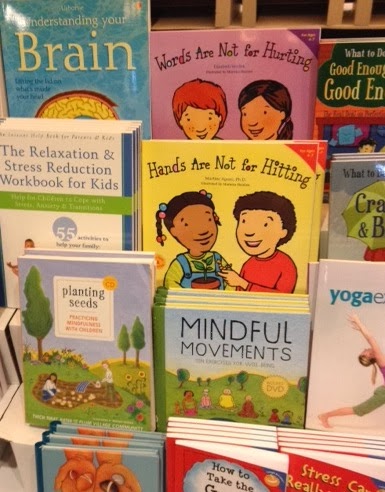
I was excited to see several books on
mindfulness featured. I promise to write a
post soon about what we're doing with
mindfulness and centering activities soon!
There were a lot of other good points made, a lot of them (like the three above) I felt were things that a lot of educators already know, but served as good reminders.

So now I'm free to roam the Hershey Lodge and sit in my plush Hershey Kiss themed hotel room until tomorrow morning! My contribution to the conference is all done, so tomorrow I get to just sit in on presentations all day! I'll try to share any nuggets of wisdom I gain from them!

I have to say, the conference SWAG(stuff we all get!) leaves a little to be desired! Haha. I remembered when you used to get full samples and books and stuff. I guess it's the recession... The Hershey bar on my pillow is pretty sweet though! (pun intended)


Click here to grab it for 3 clams.
In other news, on our last snow day I was able to put the finishing touches on two new products! The first is my gratitude journal, which has 20 days worth of prompts to help kids think about gratefulness. I'm using it in my class right now, and some of the things the kids write are really endearing.

Grab these for the ridiculously low price of 2 bucks!
You can have these for life...or 4 fried apple pies from
McDonalds for like 5 minutes. Trust me, pick this.
The second is this pack of Clean Desk Notes and Brag tags! There are notes for clean desks AND messy desks! I'm a mean ol' teacher and only leave a piece if candy with the note if the desk is clean. It serves as a great motivator when a kid comes in first thing and sees that jolly rancher on his desk...or NOT on his desk! And I don't feel guilty cause, "Hey! I told you to clean your desk!" Haha. Also, they'll get plenty more chances. I mean, I have to use all the different varieties of the notes! After several clean desk checks the kids can earn the brag tag!

Anyway, that's it til next time! Thanks for reading!

Saturday, August 10, 2013

A Week of Science Professional Development

We made claims about why the lightbulbs lit up when we
spun the dowel or handle.
First, did you know you can get paid to go to professional development workshops?! I'm not going to lie, I've gone to and presented at a number of workshops in my career, but I've never received a whopping $1,000 check for attending one until this past week. But the funny thing about the week is that I feel like the check was just a bonus to what I actually took from the workshop! I guess that's how you know it was successful! It was funded by the NSF, put on by the Earth and Space Science department and held at Penn State for those interested. Next year there are ones about Climate Change and Plate Tectonics! Join me for the Climate Change one next year!

I'm going to spread some unrelated photos from the workshop throughout this post for visual interest!

We tested different windmill
designs and made claims about
why they were more or less
efficient than the standard design.
The workshop had two components, the first was to develop content knowledge in teachers in the area of energy and energy transfers. I've mentioned before on my blog that I went to schools growing up that were pretty low on the socioeconomic scale, and quite frankly were kind of scary and didn't have the best teachers. Most of my science content knowledge was gained in college or independently when I just wanted to learn something. I'm more of a biology guy, so my understanding of the complexities of energy and energy transfers was admittedly limited. I feel like I left the workshop with a MUCH higher level of understanding, so that was a definite gain there.

We visited a "net zero" house and made claims about all
the various energy transfers that were occurring.
The second component of the workshop was truly the best part though. It could actually be argued that energy simply served as a vehicle to deliver this part. It was the pedagogical piece. As we were being exposed to the content, we were also learning about the concept of writing a "Content Storyline" that had students making claims and then providing evidence and reasoning to support those claims. 

We made claims about how this steam
engine is able to produce electricity.
I don't want to oversimplify it, but basically the content storyline consists of two parts. The first is a phenomenon, and the second is a causal story to explain that phenomenon. We had to try hard to get away from teaching about "topics" or "standards" because those aren't a phenomenon. 

We built calorimeters and BURNED food! (for science)
So to give an example, one (admittedly not engaging) phenomenon might be flicking a switch and a light comes on in the room. Or Diet Coke sinking to the bottom of a cooler while original Coke floats. Even, "He who smelt it dealt it" is a phenomenon that can be explained scientifically (diffusion.) 

The causal story would be a gapless explanation of the science behind what exactly is happening. Once you have both pieces, activities can be created to help students put the puzzle pieces together and build a really clear understanding of all the science behind the phenomenon. The whole time the kids are using claims/evidence/reasoning to develop their thinking. And more than just the standards are being met through these activities.

We played with toys and made claims about what
energy transfers/transformations were happening.
To me, the big place this differs from using a discovery/ investigation/inquiry approach to teaching science is that the whole "storyline" is built up around explaining the science behind a truly engaging phenomenon. A lot of times I think we tell kids how science works and then show them. Or we do disjointed hands-on science experiments that explain one concept. This approach has you planning out a sequence of activities that helps kids learn a multitude of interconnected science concepts while explaining the phenomenon that has them so intrigued.

I was able to work with some colleagues to begin working a bit on a mini-unit I'll be able to use this year when we study Electricity and circuits. The phenomenon we're using is this set of nighttime photos from NASA. (I'm not about to type out the causal story!)

Another phenomenon my causal story would explain would be one of those amazing Christmas light displays. Anything to get the kids excited, right?

I'm excited to see how it goes!

09 10 11 12
Blogging tips